INVESTIGATIONAL PLATFORM
How AquaBIT works
AquaBIT is being developed to transform controlled, multi-frequency electrical measurements into three-dimensional maps of tissue conductivity for repeatable oncology research.
Safety principle: in every proposed chamber configuration, the patient’s head, eyes, nose and mouth remain fully outside the water.
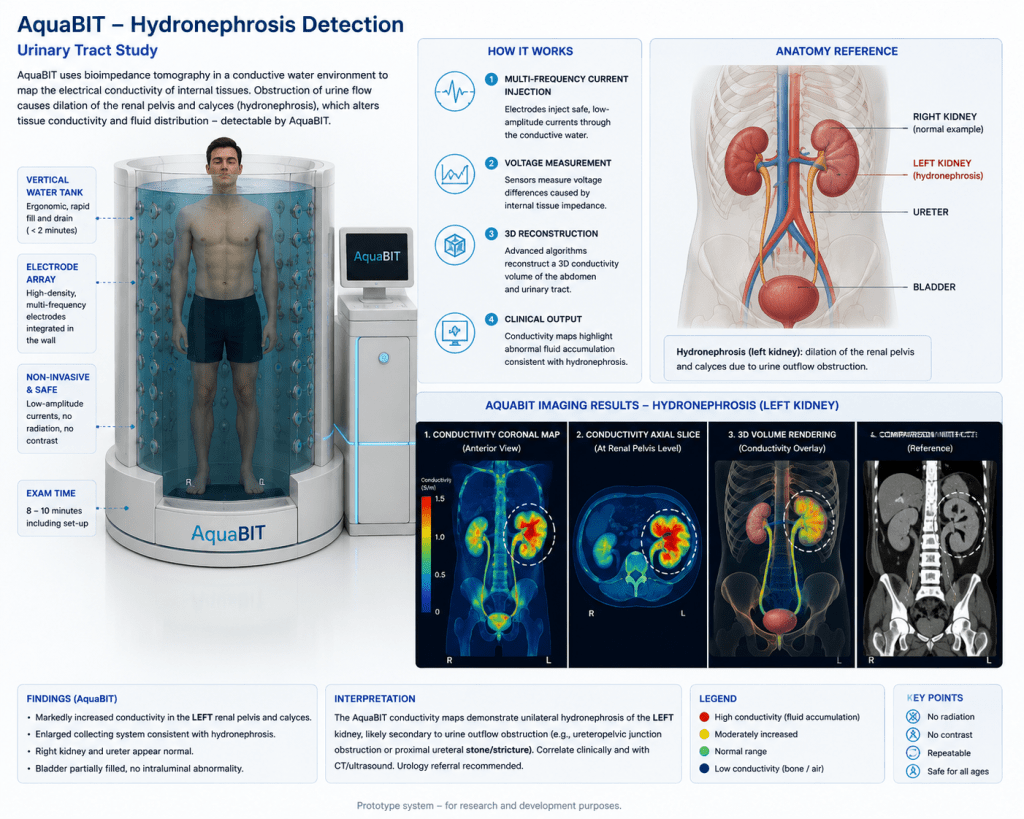
FROM PATIENT TO RESEARCH OUTPUT
A controlled six-step pathway
Every stage must be measurable, quality controlled and validated. AquaBIT remains an investigational concept and does not currently diagnose cancer or guide treatment.
01
Position
The patient is supported in a temperature-controlled chamber with assisted entry and the head completely outside the water.
02
Excite
Selected electrodes apply low-amplitude alternating currents across a controlled range of frequencies and safety limits.
03
Acquire
A distributed electrode array records voltage responses from many positions, paths and orientations around the body.
04
Quality control
The system checks water conductivity, calibration, electrode behaviour, movement and noise before accepting a dataset.
05
Reconstruct
Finite-element models, regularised inverse methods and AI estimate three-dimensional electrical tissue properties and uncertainty.
06
Compare
Investigational maps and biomarkers are compared with established imaging, pathology and longitudinal clinical outcomes.
CHAMBER CONCEPTS
Different configurations for different workflows
AquaBIT is evaluating more than one physical format. These images illustrate design directions rather than a final manufactured or clinically approved system.
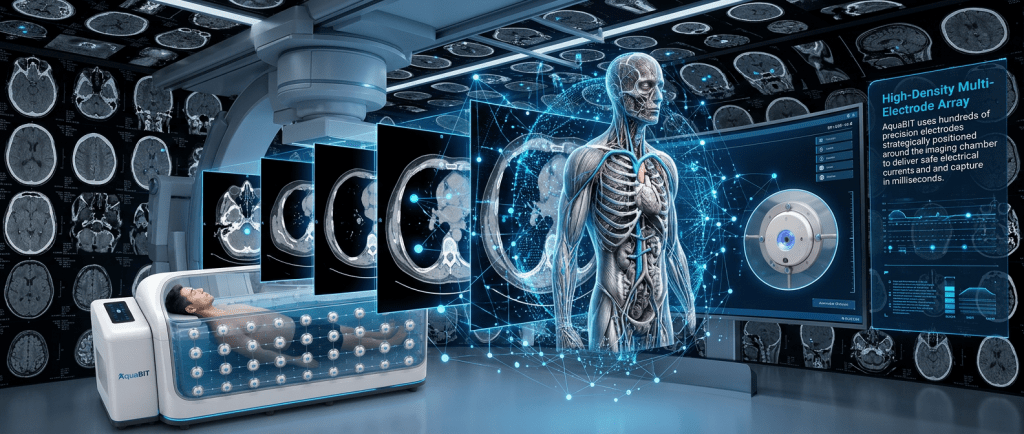
HORIZONTAL CHAMBER
Supine assisted examination
A supported horizontal format may suit radiology-style workflows, controlled positioning and patients who cannot stand comfortably.
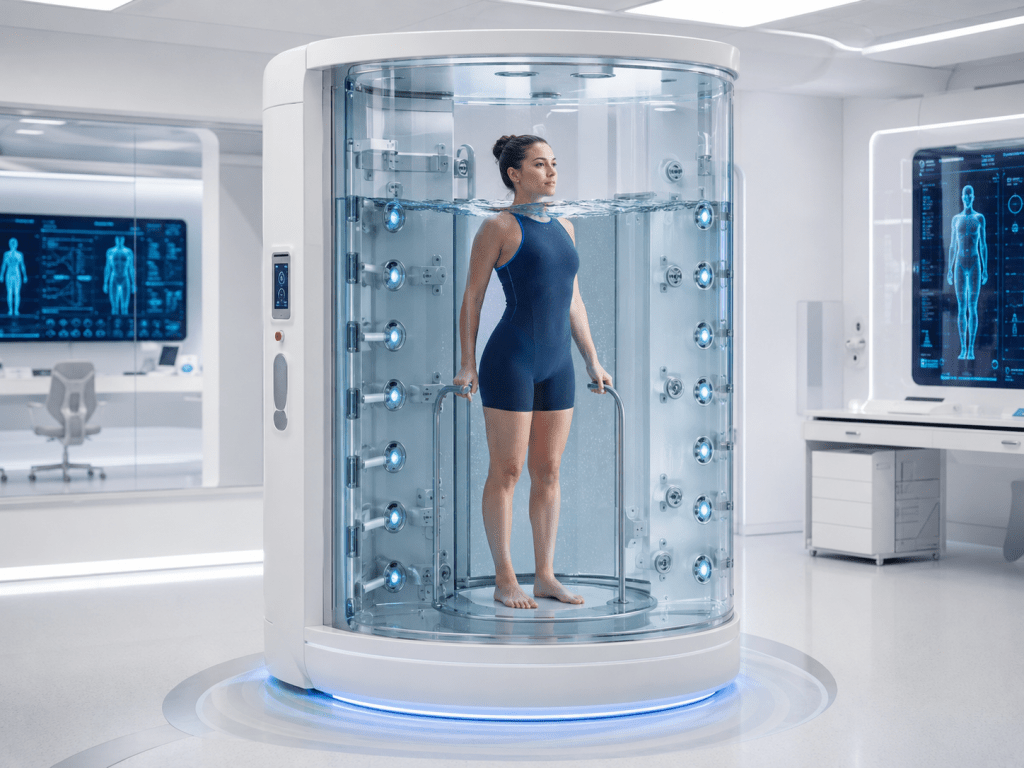
VERTICAL CHAMBER
Standing walk-in concept
A vertical format may reduce the equipment footprint and support rapid access for independently mobile patients, with assisted steps and handrails.

SYSTEM ARCHITECTURE
The chamber is only one part of the platform
Each configuration must integrate the water vessel, embedded electrode array, acquisition electronics, calibration controls, patient-support systems and a physics-informed reconstruction workstation.
The final design will be selected through modelling, engineering, human-factors assessment and preclinical validation.
PATIENT JOURNEY
Safe entry and exit are part of the design
- Prepare: confirm suitability, explain the procedure and standardise clothing, position and water conditions.
- Enter: use assisted steps, a transfer platform or a height-adjustable support according to the selected chamber.
- Measure: maintain continuous communication and monitoring with an immediate drainage and emergency-exit pathway.
- Exit: drain or lower the water level, assist the patient onto a dry platform and complete post-procedure checks.
What AquaBIT does not yet claim
AquaBIT does not currently diagnose cancer, replace established imaging or guide treatment. The first task is to demonstrate detectable signal contrast, repeatability, spatial localisation, safe workflow and agreement with appropriate reference standards.

