THE AQUABIT PLATFORM
Water-assisted bioimpedance imaging for oncology research
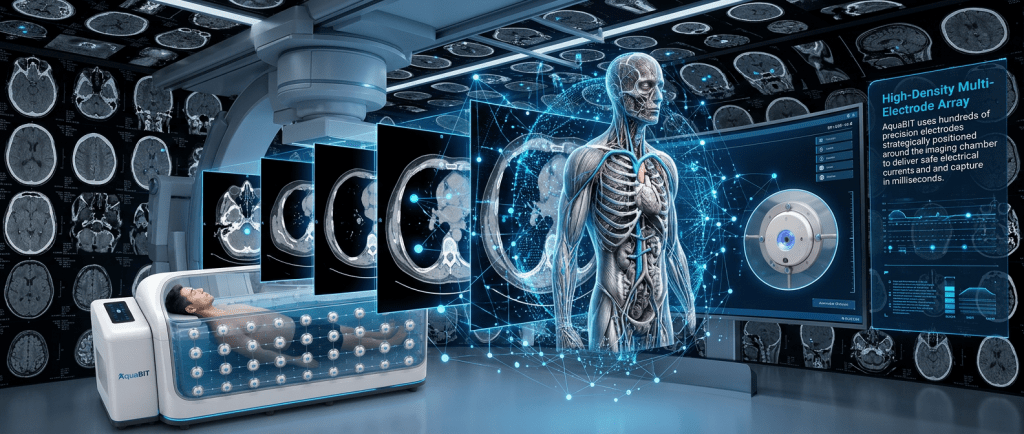
AquaBIT is an investigational imaging platform designed to acquire multi-frequency electrical measurements around the body and reconstruct them as three-dimensional conductivity maps for repeatable tissue-characterisation research.
AquaBIT is under development. It is not approved for diagnosis, treatment selection or patient management.
THE CORE IDEA
Measure electrical behaviour without placing hundreds of electrodes on the skin
Biological tissues respond differently to alternating electrical current, and that response changes with signal frequency. AquaBIT is designed to measure these differences from many directions using an electrode array built into a water chamber rather than a large number of individually positioned surface electrodes.
The surrounding water acts as a shared conductive interface between the body and the array. This may support more consistent coupling, broader angular sampling and repeated acquisition under controlled conditions. These advantages remain hypotheses to be quantified through modelling, phantom studies and prospective clinical research.
WHY WATER?
A controlled electrical interface around the body
Consistent coupling
A temperature-controlled conductive medium is intended to reduce variation caused by electrode placement and local skin contact.
Dense measurements
Embedded electrodes can inject and sense signals across multiple paths, frequencies and viewing angles around the anatomy.
Repeatable positioning
Controlled water level, patient support and acquisition protocols are designed to enable longitudinal comparison.
Water does not by itself guarantee image quality or clinical accuracy. Those outcomes depend on calibration, signal-to-noise performance, reconstruction error, biological variability and validation against accepted reference standards.
FROM SIGNAL TO IMAGE
A six-step measurement and reconstruction pipeline
01. Prepare
Standardise patient position, water properties, temperature and system calibration.
02. Excite
Apply imperceptible, low-amplitude alternating currents within predefined safety limits.
03. Acquire
Record voltage responses across many electrode combinations and frequencies.
04. Control
Reject artefact, monitor drift and attach quality and uncertainty measures to the dataset.
05. Reconstruct
Use physics-based models and computational methods to estimate conductivity distributions.
06. Compare
Assess serial change and compare research outputs with MRI, CT, ultrasound or pathology.

SYSTEM ARCHITECTURE
One platform, five coordinated layers
- Patient interface: chamber, support platform, water control and safe entry and exit.
- Electrode array: multiplexed current injection and voltage sensing around the body.
- Acquisition electronics: multi-frequency generation, synchronisation, amplification and calibration.
- Reconstruction engine: anatomical models, inverse solving, uncertainty estimation and quality control.
- Research interface: three-dimensional maps, quantitative change metrics and export for comparison with reference imaging.
ENGINEERED FOR RESEARCH SAFETY
Safety and data quality must be designed together
Electrical protection
Current limiting, isolation, continuous monitoring and automatic shutdown are core design requirements.
Patient protection
The head remains fully above water, with controlled filling, drainage, support and emergency access.
Measurement integrity
Calibration checks, motion detection, artefact rejection and uncertainty reporting govern usable data.
PATIENT ACCESS · BATH-FORM CONCEPT
How the patient enters and leaves AquaBIT
The chamber remains empty during entry and exit: a patient should never have to climb into a water-filled bath. The proposed access pathway combines a low-threshold side opening with supported-transfer options, controlled filling and rapid drainage.
The precise mechanism will be refined through human-factors engineering and co-design with patients, radiographers, nurses, physiotherapists and manual-handling specialists.
01 · PREPARE
Empty and accessible
The bath is empty and dry. Staff complete screening and system checks, open the side access and prepare the appropriate transfer aid.
02 · ENTER & POSITION
Walk in or transfer
Ambulant patients use a low, non-slip threshold and handrails. Patients with reduced mobility may use a height-adjustable transfer seat or an approved hoist pathway.
03 · CONTROLLED FILL
Water rises gradually
After positioning and door interlock checks, conditioned water fills slowly to the prescribed level below the neck. The patient’s head remains fully above water.
04 · ACQUIRE
Supported throughout
The patient remains supported and in continuous communication with staff. Acquisition can be paused at any time, with emergency stop and rapid-drain controls immediately available.
05 · DRAIN & EXIT
Water out before the patient
The chamber drains completely before the access door opens. Staff then assist the patient through the same low-threshold route or supported-transfer pathway.
Essential access safeguards
- Entry and routine exit only with the chamber empty.
- Non-slip surfaces, handrails and adjustable body support.
- Accessible transfer options for patients with limited mobility.
- Water-level and door interlocks with redundant rapid drainage.
- Manual emergency procedures, continuous staff attendance and the head fully above water at all times.
Design status: This is a proposed patient-access concept for engineering and human-factors development. Final geometry, transfer aids, interlocks and emergency procedures will require formal risk assessment and usability validation.
ONCOLOGY APPLICATION
Designed for repeatable treatment-response research
AquaBIT’s initial oncology hypothesis is that serial conductivity maps may reveal measurable changes in tumour tissue during systemic therapy or radiotherapy. The objective is a complementary functional research signal, not a replacement for established imaging, pathology or clinical assessment.
Potential value would depend on demonstrating repeatability, clinically meaningful correlation and additional information beyond current standards in prospective studies.

What AquaBIT must prove
- Electrical safety and reliable operation across the intended patient population.
- Stable acquisition and reconstruction under controlled and clinically realistic conditions.
- Repeatable conductivity measurements and transparent uncertainty estimates.
- Agreement with appropriate physical phantoms and accepted clinical reference standards.
- Prospective evidence that the output is useful within a clearly defined oncology pathway.
These questions define the AquaBIT research programme and will determine whether the technology can progress towards clinical evaluation.
Help us test the platform rigorously
We welcome discussions with oncology centres, bioimpedance engineers, computational-imaging groups and research partners.
Trust, evidence and responsible development
Development & Regulatory
Current stage, evidence gates, safety strategy and provisional regulatory direction.
Data, AI & Privacy
How imaging data, reconstruction software and responsible clinical AI will be governed.
Frequently Asked Questions
Plain answers about water, electrical safety, evidence status and clinical availability.
Read the AquaBIT White Paper
Explore the scientific basis, proposed system architecture, oncology research hypothesis, safety framework and staged evidence pathway.
Molecular–spatial framework
Keep measured, derived and inferred information explicit.
Measured: blood biomarkers and multifrequency electrical signals. Derived: conductivity reconstruction and tissue characterisation. Inferred: molecular-to-spatial associations that require prospective validation.

